
1. The geometry of power transmission
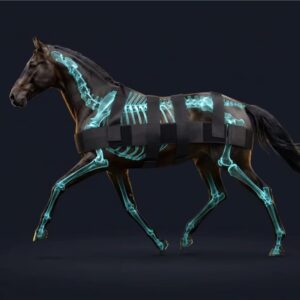
During the active movement phase (shown here at the trot), enormous shear forces act on the
Horse's body. The glowing lines of our analysis illustrate the biomechanical network that connects the forehand to the hindquarters. Equimpulse targets precisely the nodes of these force vectors to efficiently channel energy through the body rather than letting it dissipate in unstable joints.
2. Active stabilization of the tensegrity points
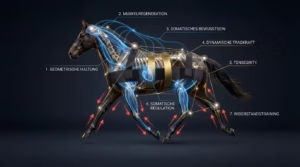
Our system is not a passive belt, but a reactive support corset. The corset-like band lies exactly over the neuralgic points of the Biotensegrity:
• The shoulder vector: Stabilizes the base of the neck and frees the shoulder blade for greater reach.
• The central fixation: Supports the rib cage and activates the abdominal muscles. This prevents the spine from sagging under load.
• The hindquarter impulse: The thrust of the hind legs is directed into a forward-upward movement and encourages stepping under.
3. Orthopedic Feedback
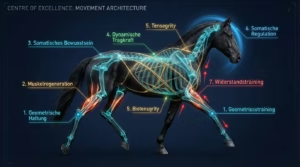
in real time. The custom-made elastic material from Equimpulse offers a permanent, but measured resistance. With every stride, the horse's brain receives via a neuronal feedback loop. This improves the Somatic Awareness (improved body awareness) and leads to a measurably higher sure-footedness and cadence.
4. The function of the orthopedic body band
While conventional systems often only have a superficial effect, the Equimpulse corset intervenes deeply in stabilization. It acts as external fascial network, which activates the deep core muscles. This supports the horse's spine from the inside out – an essential factor for the long-term health of sport and leisure horses.
Summary of the analysis:
The visual overlay of the skeleton model and EquImpulse system proves: our design follows anatomy, not fashion. We are optimizing the Geometry of motion, to fully unleash the natural performance of your horse – ethical, well-founded, and customized.